

Trenchless Pipe Rehabilitation
Preserving Infrastructure with Minimal Disruption
Our Trenchless Pipe Rehabilitation division specializes in repairing and renewing aging underground pipelines without the need for extensive excavation. Led by experienced engineers, we utilize state-of-the-art technologies such as Cured-In-Place Pipe (CIPP), pipe bursting, and slip-lining to restore structural integrity and improve flow capacity.
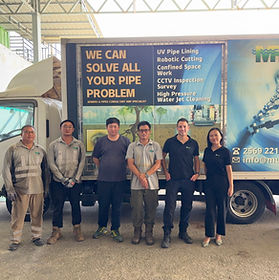
Global Training Excellence
We believe that continuous learning is the cornerstone of exceptional service. By partnering with world-leading industry experts—including Impreg, Saertex, and IBG—we ensure our staff stays at the forefront of cutting-edge technology and modern methodologies. Our team members regularly participate in intensive hands-on programs, successfully earning prestigious certifications upon completion. These continuous global partnerships not only validate our expertise but also equip our workforce with specialized skills. Ultimately, this ongoing commitment to professional development enables us to deliver top-tier quality, enhanced safety, and unmatched performance for every project we undertake.

Repair common pipes
The Pipe Renovation System of Renopipe Liner is a system designed to rehabilitate various pipes including drainage, sewage, gas lines and cooling mains.
With this system, the liners are perfectly able to rehabilitate pipes from 45-2500mm in diameter (DN 45 up to DN 2500) due to damage, leakage and joint displacement in concrete, clay, steel and UPVC pipes.

Repair pressure pipes
The Pipe Renovation Lining System of IBB16 is a hybrid system (without bonding with the old pipe) designed to rehabilitate pressure pipes including drainage, sewage, gas lines and cooling mains.
The system combines two pipe liners (the IBG UV + Steam systems) with different properties to achieve the required criteria for the rehabilitation of a pressurized water pipe. With this system, the liners are perfectly able to rehabilitate pipes from DN150-2000mm can be used in pressure pipes up to an operating pressure of 232 psi (16 bar).

Closed-Ciruit TV (CCTV) & Pipeline Survey
Closed-circuit TV surveying is done before and after all lining installations.CCTV inspection can be done by inserting a camera into the pipes. Depending on the pipe diameter and condition. The type of camera used would normally be mounted on a wheeled crawler in larger pipes or be inserted by using a push-rod method in smaller pipes. As the camera moves along the pipe, we would be able to identify the structural or surface defects by our Pan & Tilt Camera system. After the inspection, a detailed “WRC” certificate CCTV survey report with photos and video footage will be submitted to our clients, showing the pipe condition in a more presentable way.

Pipe Robotic Cutting
When obstructions in a pipe are required to be removed and/or the obstructed lateral openings are required to be reopened, a Cutter Robot could be used in these occasions.
MULTIPIPE is equipped with IMS TURBO Cutter Robots and Pipetronic Hydraulic milling robot PI.CUTTER which enable our crew to clear obstructions within narrow pipes with a nominal dimension of 200mm to 800mm and can be supplied with electric, air or hydraulic power.

Confined Space Work
Our company has a highly skilled and trained team, experienced in working safely in confined space environments, such as manholes. The following information details the equipment used, the risk assessment process, and the precautionary measures implemented to ensure safety.

High Pressure Jet Cleaning
The purpose of High Pressure Water Jetting is to clean the surface of the drain. The intensity of water jetting would depends on the actual pipe condition but nevertheless, the water jetting is a powerful equipment and is proven to be a more efficient method than the conventional drain rods. The cleaning process is done by delivering the water along the hose to the nozzle. The water is then propelled within the pipe as the nozzle travels along the pipe. The applied pressure ranges from 300 to 700 bar, depending on the condition of blockage or the type of obstruction. The nozzle normally would be rotated manually to provide 360° pipe clearance along the pipe.

-
Reduced disruption
-
Cost-effective (less than 60% of cost for replacement)
-
Minimal environmental impact
-
Ease of application
-
Reduced installation time
-
Internationally recognized and preferred method
BENEFITS Of "No Dig"


